
Is Your 7-Seat Occupied?
Every company needs a seat for governed knowledge. Most leave it empty. AI exposes the cost.
There's a seat for brand and product truth in every organization. It's often empty. AI is exposing the cost.
The Open Seat
In “Truth. The Stack Business Never Built,” we discussed how AI has turned truth into infrastructure. When brand and product truth isn’t explicitly defined, governed, and made machine-readable, AI assembles it anyway—internally and externally.
In “Context Does Not Equal Truth,” we showed what breaks when organizations try to scale AI execution on context alone. We demonstrated why brand and product truth must exist as a governed layer above execution, performing the critical function of translating strategy into execution.
This function serves as the arbiter of truth on behalf of the organization, making strategy executable for humans and AI. Borrowing from rowing, we termed this function the 7-seat.
This article addresses the final—and perhaps most uncomfortable—question the first two surfaced but did not answer:
If brand and product truth is now infrastructure and execution depends on it, where does the 7-seat sit in the organization?
The answer is a leadership imperative.
From Human Speed to AI Speed
AI didn’t introduce ambiguity into organizations. It removed the buffer that used to hide it.
For decades, execution moved at human speed. When interpretations diverged, people noticed. They corrected course in meetings, training sessions, and hallway conversations. Misalignment was uncomfortable, but survivable.
That buffer is gone.
AI systems now execute continuously—generating content, prioritizing accounts, answering product questions, and shaping how your company is represented thousands of times a day. They don’t ask for clarification. They don’t pause for alignment. They execute against whatever they’re given.
Which raises a question most organizations have never explicitly answered:
Who decides what’s true before execution begins? Because if no one decides, AI will.
The C-Suite is Aligned for Humans
The modern C-suite is designed to optimize execution. Each role exists to turn strategy into action within a defined vertical.
Marketing executes narrative.
Product executes roadmap.
Sales executes pipeline.
RevOps executes efficiency.
IT executes systems.
That structure works when humans are the execution layer.
It assumes decisions can be held implicitly across leadership, translated into context within each function, and reconciled through conversation, judgment, and memory as execution unfolds.
AI fundamentally breaks that assumption.
Execution no longer waits for reconciliation. It doesn’t attend the offsite. It doesn’t remember what was agreed to. It executes continuously, pulling from whatever context is accessible.
Each executive still owns context for their team—and that remains necessary. But context depends on truth. And context is now consumed not just by people, but by machines.
What’s missing isn’t another executive role.
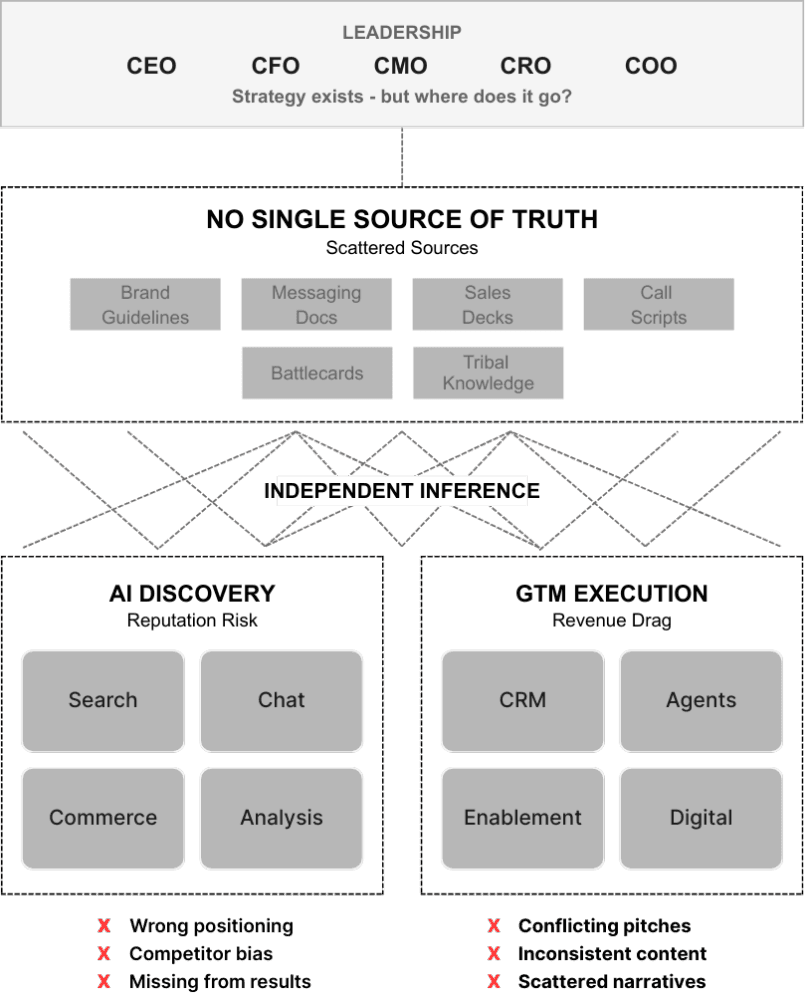
What’s missing is truth assembled horizontally across the C-suite—explicit, governed, and executable—so every function, human, and system derives context from the same source.
Without a single source of truth, execution doesn’t slow down. It diverges from the start.
It’s Not About Better Documentation
This isn’t a failure of alignment. It isn’t a failure of communication. And it isn’t a chief-of-staff problem. It’s a failure to operationalize truth for a workforce that increasingly includes machines.
Documents assume humans are the execution layer. Meetings assume memory and judgment. Alignment assumes interpretation will converge.
AI doesn’t work that way.
Machines don’t remember the offsite. They don’t know which deck mattered. They don’t know which decision superseded another.
They execute whatever is accessible.
When leadership decisions are not assembled, governed, and made executable as a single source of truth, AI doesn’t surface the disagreement. It resolves it silently—then scales that resolution everywhere. No amount of documentation will fill that hole.
It’s Not an Organizational Problem
Functions exist to execute strategy. Truth exists to constrain execution. That distinction matters.
Anything that lives inside a function will be interpreted through that function’s incentives. CRM fields reflect past execution. Prompts encode yesterday’s assumptions. Documentation reflects whoever updated it last.
AI systems don’t know which version is authoritative. When they encounter conflict, they don’t escalate. They infer. And inference is not judgment. It’s automated pattern completion.
Here’s the execution failure pattern now playing out in company after company:
Strategy gets declared -> Alignment gets reached -> Decisions get made -> Execution begins -> Context gets distributed.
But truth never gets resolved into an executional constraint. Execution proceeds anyway.
AI didn’t create this gap. It made it operational.
Where Truth Must Sit
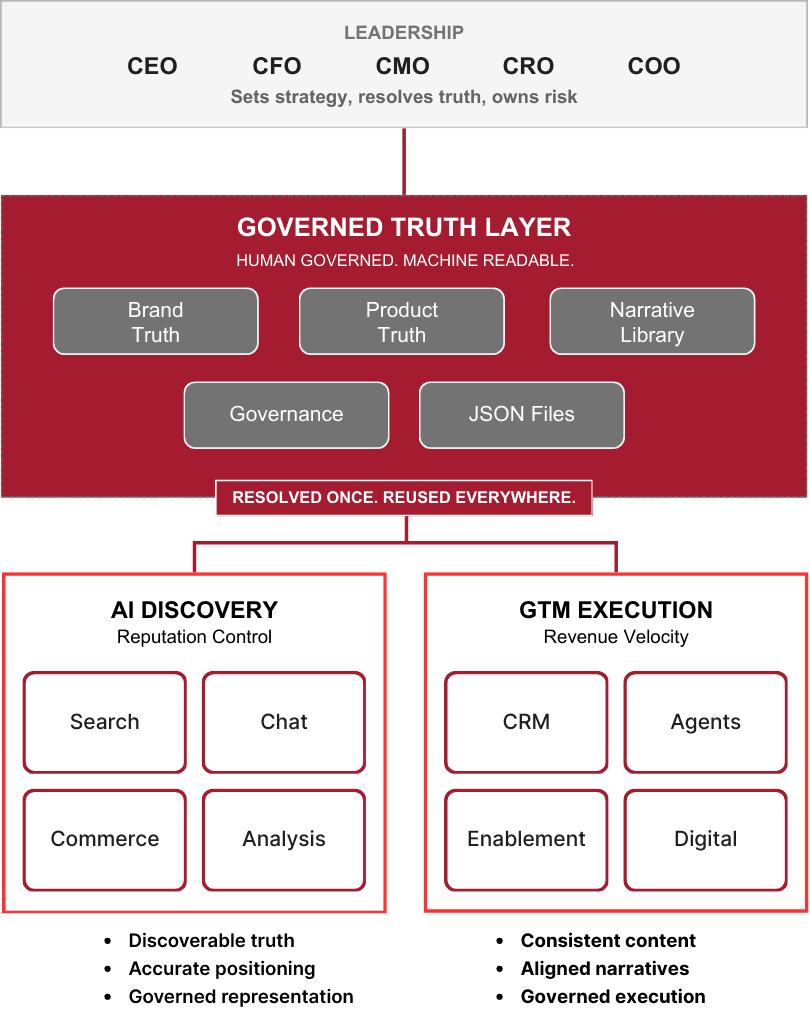
Truth cannot live inside decks, workflows, CRM fields, or prompts. Those are consumers of truth, not arbiters of it.
It has to live above execution and below strategy, as shared infrastructure. Anchored at the leadership level with explicit authority.
Finance has a general ledger. Engineering has source control. The business needs the same thing for brand, product, and go-to-market truth. Not as a document. Not as a slide. As a system of record that execution systems consume without reinterpretation. This is a placement question, not a tooling one.
Filling the Seat is a Leadership Imperative
The decision of what is true before execution begins cannot live inside a function. It cannot be delegated to tools. And it cannot be inferred by AI. It has to be resolved at the leadership level, as shared infrastructure—above execution and below strategy.
This is the role the 7-seat exists to fill.
If no one can point to where truth is assembled once and consumed everywhere, the 7-seat is already empty.
Execution is already happening—continuously and at increasing scale. When the 7-seat is empty, AI doesn’t pause. It fills the gap with inference. Filling the 7-seat is not optional. It is the cost of operating at AI speed without losing control.
Read More:
Article 1: Truth. The Stack Business Never Built
Article 2: Context Does Not Equal Truth